Abortion Accessibility Act

Why this matters

Abortion is a safe, legal health procedure that many women will choose at some point in life. California is one of only six states which require insurance plans to cover this care, but unfortunately many birthing people still face high cost-sharing burdens. Eliminating financial barriers is critical to ensuring that all birthing people, regardless of income, can access the care they need in a timely manner.

What our bill does

SB 245 removes co-payments and deductibles, and others costs charged to patients seeking abortions with private insurance.

Period Equity

Why this matters

Not being able to afford or access menstrual products can result in the loss of educational, employment, and other opportunities. California is the world’s fifth largest economy, and it is time that we join the international movement that is demanding equality for women and menstruating people.

What our bill does

AB 367 would require public schools that maintain any combination of classes from grades 6 to 12, California State Universities and Community Colleges, and public institutions to stock at least 50% of restrooms with free menstrual products at all times.

Cruel & Pernicious: BWWAP Condemns Texas’s Abortion Ban, S.B. 8

Black Women for Wellness Action Project (BWWAP) vehemently opposes the Texas abortion ban and we are deeply saddened to learn of the Supreme Court’s recent 5-4 decision blocking review of Texas’s unduly restrictive abortion legislation, S.B. 8.
 

The Texas law bans abortions after about six weeks of pregnancy, which is before many people even become aware that they are pregnant, and allows no exceptions for instances of rape or incest. The ban also enables abusers to obtain control over a person’s reproductive rights by empowering anyone to sue to prevent a pregnant person from terminating their pregnancy. Moreover, the ban makes ordinary citizens bounty hunters, by incentivizing individuals to sue doctors and others who help a person access abortion with a $10,000 reward. SCOTUS’s unwillingness to intervene will effectively prevent women in Texas from exercising the constitutional rights that its landmark Roe v. Wade decision guarantees.

The abortion ban and SCOTUS’s failure to review the ban continue this country’s tradition of suppression of our sexual and reproductive rights. Black women and people with uteruses’ reproductive freedom and bodily autonomy, in particular, have been systematically restricted and attacked throughout our nation’s history; the ban and the failure to review the ban are simply more unjust burdens that will be felt most heavily by Black women and women of color. We have been denied the resources, services, and information necessary to make personal medical decisions about if, when, and how to parent. Not only are Black women and birthing people more likely to lack sex education and birth control access, but we also experience pregnancy-related complications and death during childbirth at a rate much higher than our white counterparts. Now, if we live in Texas, we must also seek alternatives, such as traveling hundreds of miles to another state to access abortions, which impose a significant financial burden.   

The disproportionate impact of COVID-19 has exacerbated the economic hardship and family obligations many Black women and parents already face—making options like out-of-state travel to obtain medical care a major obstacle, and therefore preventing people from making the reproductive choices that are best fit for them and their families. Moreover, those living with multiple marginalized identities in addition to being Black and femme—those who are disabled, currently or formerly incarcerated, LGBTQ+, low-income, survivors of domestic violence or intimate partner violence—are placed in an especially vulnerable position that makes it difficult to secure and exercise their reproductive rights.

 “S.B. 8 is a cruel and pernicious piece of legislation through which the Texas legislature masterfully engages its citizens to infringe on the constitutional rights of an entire class of people. It sanctions the surveillance and policing of the bodies of women and people with uteruses in an unprecedented way,” said Onyemma Obiekea, Policy Analyst, Black Women for Wellness/Action Project. This law is harmful in so many ways and is truly worrisome, as it creates a blueprint for other state legislatures to follow suit. SCOTUS’s refusal to intervene functions as a signal — a green light for states to enact these types of blatantly unconstitutional laws. The recent events underscore the importance of our participation in the political process — officials elected to office at all levels have a direct impact on our ability to lead a full, dignified, and free existence. The misplaced priority of the legislature is disconcerting; rather than making investments to improve access to healthcare or decrease the staggering maternal mortality rates, for example, it prioritizes oppression and surveillance of its very citizens.”  

 BWWAP denounces the Texas abortion ban. We stand with the women and other pregnant persons, families, health providers, and advocates in Texas who are raising their voices against this law! We will proudly continue the fight to advance reproductive justice and abolish oppressive structures that jeopardize our reproductive freedom, by building the political power of Black women in California.
Healthy Futures for Foster Youth

Why it matters

California’s foster youth and nonminor dependents experience disproportionately high rates of sexually transmitted infections, unintended pregnancy, and poor access to prenatal care. This burden falls heavily on Black youth, who are overrepresented in our state’s foster system by 3.1x their share of the general population. This is a complex and intersectional issue, but there are some immediate ways we can support these youth. Providing financial support to expectant parents is shown to reduce negative maternal and child health outcomes of stillbirth, miscarriage, low birth weight, and complicated pregnancy.

What our bill does

AB 366 improves upon existing law in three ways: it extends expectant foster youth’s infant supplement payments by three months to cover the final term of pregnancy; it ensures foster youth have access to comprehensive sexual health education, rights, and services; and it creates transparency through additional data reporting.

STD Coverage and Care Act

Why this matters

For the past three decades, the rates of sexually transmitted disease (STDs) have continued to climb in California. Chlamydia and gonorrhea are becoming more prevalent and can have long-term health effects if left untreated.  Syphilis has risen at an especially alarming rate (nearly 900% between 2012-2018!) and can cause serious harm to adults and to newborns during childbirth. Young adults and Black people face disproportionately high rates of infection, and addressing this requires removing barriers to testing and treatment.

What our bill does

SB 306 helps to addresses the STD epidemic and improve health outcomes by reducing barriers to STD services and treatment by:

  • Expanding access to STD services and treatment for low-income and uninsured patients through the Family PACT program and provider network
  • Increasing prevention through innovative strategies like home testing + expansion of health professionals that conduct rapid testing in the community
  • Revising current law to support the delivery and increased utilization of Expedited Partner Therapy (EPT). This evidence-based and effective STD prevention practice provides patients who test positive for chlamydia or gonorrhea with take-home medication or perscriptions for their sex partners.
  • Updating state law to require congenital syphilis testing during the third trimester of pregnancy

California Did What Needed to Be Done.

California did what needed to be done!

Together we defeated the attempted right-wing power grab and democracy lives to see another day in California! Californians understood the assignment and executed accordingly. This win is not just about keeping Gov. Gavin Newsom in office. It is about Saving Democracy in California and affirming the voice of our state’s citizens. It is about preserving our values and advancing health equity and reproductive freedom.

As an organization, we recognized the implications of this special election. We knew what was at stake — progressive policies that advance the health and well-being of Black women and girls. So, we went to work. Through a robust communications and field campaign, grassroots community and business engagement, as well as strategic partnerships, we galvanized our communities to take a stand for our values.

Leading up to the election, BWWAP:

  • Placed ads statewide from Los Angeles to the Bay Area reaching hundreds of thousands of voters in South LA, Compton, Watts, Inglewood, Palmdale, Lancaster, Oakland, Stockton, Fresno and beyond through mobile app ads, billboards, wheat postings and local newspapers
     
  • talked with more than 6,500 voters on the phones to ensure they understood the process, had a plan to vote, understood what was at stake and the importance of voting no in the election
     
  • Ran No on the recall radio ads heard by over 100 thousand people in Los Angeles
     
  • Connected with 65+ businesses in South LA to share the no on the recall message with them and encourage them to promote a no on the recall message to their clients
     
  • Partnered with BIPOC lead and serving organizations lead by Courage California to host a youth focused stop the recall rally where we engaged, energized and educated attendees on the issues at stake
     
  • Partnered with Naral Pro-Choice California and Planned Parenthood Affiliates of California to host a stop the recall reproductive freedom phone bank that featured elected officials and community leaders who offered their insights with volunteers and underscored the importance of voting no in this special election 

We are deeply grateful to Million Voters Project Action Fund and The Grove Action Fund, for  their financial support, which enabled us to work with our community to secure this win!  Together we were able to make sure that California has leadership that demonstrates an interest in expanding access to healthcare, closing the disparities gaps and advancing health equity. We look forward to working with Governor Newsom as he has been a great partner in BWW’s mission to expand healthcare access and reduce racial disparities maternal health and other health indicators. 

In Solidarity,

Black Women for Wellness Action Project

Op-Ed: How to Improve California’s Deadly Record of Outcomes for Black Births

BWWAP Executive Director teamed up with our partners at Western Center on Law and Poverty to publish this piece in CalMatters.org. A recent report from CA Dept. of Public Health shows Black mothers in our state face higher maternal mortality rates than the rest of the country. We identify solutions to this ongoing and widening disparity, and urge the Governor to take action by signing SB 65 into law.

BWWAP Co-Creates California Future of Abortion Council

In the wake of anti-abortion legislation enacted in Texas, BWWAP joined ACCESS, NARAL, NHeLP, and Planned Parenthood Affiliates of California in forming the California Future of Abortion Council. We will convene to discuss policy solutions that help California ensure equitable abortion access. Already, our state has enacted laws aimed at protecting the rights of patients.

Re-imagining Maternal Health

Why this matters

Black women face unacceptably high rates of maternal mortality. Black mothers across the U.S. (including here in California) are more than three times as likely to die from pregnancy-related complications as white women, and this holds true across incomes and education levels. While all women giving birth in the U.S. face poorer health outcomes than people in similarly developed nations, Black women and infants persistently experience the worst morbidity and mortality rates. This is unconscionable, and complex. Previously, BWWAP passed a bill to require hospital staff to be trained on implicit bias– one obstacle Black women commonly face when accessing health care– but pregnant women need a full range of services to support them throughout pregnancy, during delivery, and after giving birth.

What our bill does

We have put together a comprehensive legislative packet aimed at reducing maternal mortality and morbidity as well as expanding and redefining maternal healthcare in California. The package includes:

  • Expanding full spectrum doula coverage in MediCal
  • Extending Postpartum coverage in Medi-Cal
  • Codifying and expanding California’s Maternal Mortality Review Board
  • Updating Fetal and Infant Maternal Investigation
  • Expanding access to midwifery programs
  • Universal Income for low and middle-income pregnant people
  • Updating data collection on mortality and morbity experienced in Lesbian, Trans and Gender Non-Confirming communties
  • Reviewing climate impact on birthing outcomes
  • Requiring recommendations to close racial disparity gaps

Legislative Victory

We are thrilled to share that this bill was signed into law on October 4, 2021. Much of the funds needed to implement our proposed policy changes were also included in the California state budget signed by Governor Newsom in July 2021. This is a historic step forward in the fight for reproductive justice, and we thank the Governor, Senator Skinner and her staff, and the many advocates and community partners who worked hard alongside BWWAP to make this happen. We look forward to continuing to build on this success.

Right after the bill was signed, our team went to work reaching out to and educating folks who might benefit. We are spending the last months of 2021 knocking doors and calling women and families to make sure they know about the new law. Find out more about Momnibus benefits and our outreach campaign.

You can learn more about this by watching the Governor’s virtual bill signing ceremony (featuring BWWAP’s Executive Director, Nourbese Flint!), reading our Op-Ed in CalMatters, and in our press release.

Reproductive Justice Includes Challenging Police Violence

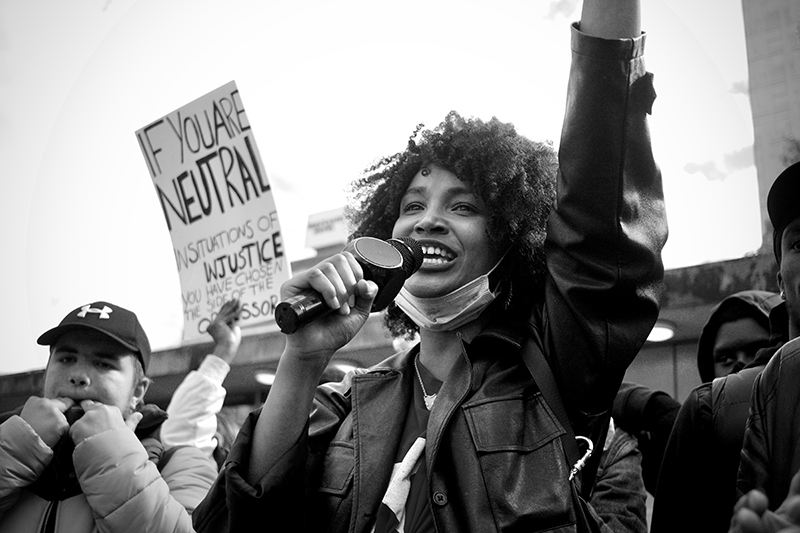
Black women have a long history of boldly confronting injustice. In the wake of violent and aggressive police response to protests after the murder of George Floyd, BWWAP joined other national voices to call for alternative actions that shift power and support Black unities.